
Best neck massager: what makes one good, rather than just well reviewed
Almost everything sold in this category will do something to a tight neck for ten minutes. That is not the question worth asking. The question is whether you will still be reaching for it in six weeks, and that turns out to be decided by a small number of design choices that are easy to check on any product listing and almost impossible to fix afterwards.
The six things that make the best neck massager
We sell one massager, so this is not a round-up. It is the list we used to decide what to stock, applied to the device we ended up with. Each of the six is checkable from a product page in a few seconds.
| What to check | Why it decides usage | Where ours stands |
|---|---|---|
| Kneading or vibration | Kneading presses and releases one point at a time. Vibration spreads energy across the surface and does less to a contracted muscle. | Two hand-shaped heads, five silicone fingers each |
| Hands free or handheld | A device you hold makes the arm do the static work that tightened your shoulders in the first place. | Rests over the shoulders, both hands free |
| Who sets the pressure | A dial gives three fixed amounts. A buckled strap adds a fit adjustment on top, so the same device suits a slim neck and a firm preference. | Set by how tightly the strap is buckled |
| Cable or battery | A device that plugs in gets used where the socket is, not where you sit. | Cordless, full charge in about three hours |
| Heat that switches off | Warmth helps a contracted muscle. In summer, or on a sore area, you want the kneading alone. | Two heat levels, 42 and 45 °C (108 and 113 °F), independent of the massage |
| Reach beyond the neck | A device limited to the neck is used for one thing. Reach changes how often it comes out. | Neck, trapezius, shoulders, waist and calves |
Why kneading is the one that cannot be traded away

If you only check one thing, check this. A tight trapezius is a muscle held in contraction, and what releases it is pressure applied to a point, held, and let go — the thing a pair of thumbs does without being taught. Vibration is a different physical event: a motor shakes a housing, the housing shakes the skin, and the energy dissipates across everything it touches. It is genuinely pleasant. It is not the same intervention.
This is why the number of contact points matters more than the number of settings. Two hands carrying five fingers each give ten points that press and release in sequence, and because they sit either side of the spine they cover both shoulders at once rather than one at a time. One buyer who had owned a vibrating collar described the difference simply: the fingers are all separate, and you feel it clearly even on a slim neck.
The trait nobody lists, and everybody feels
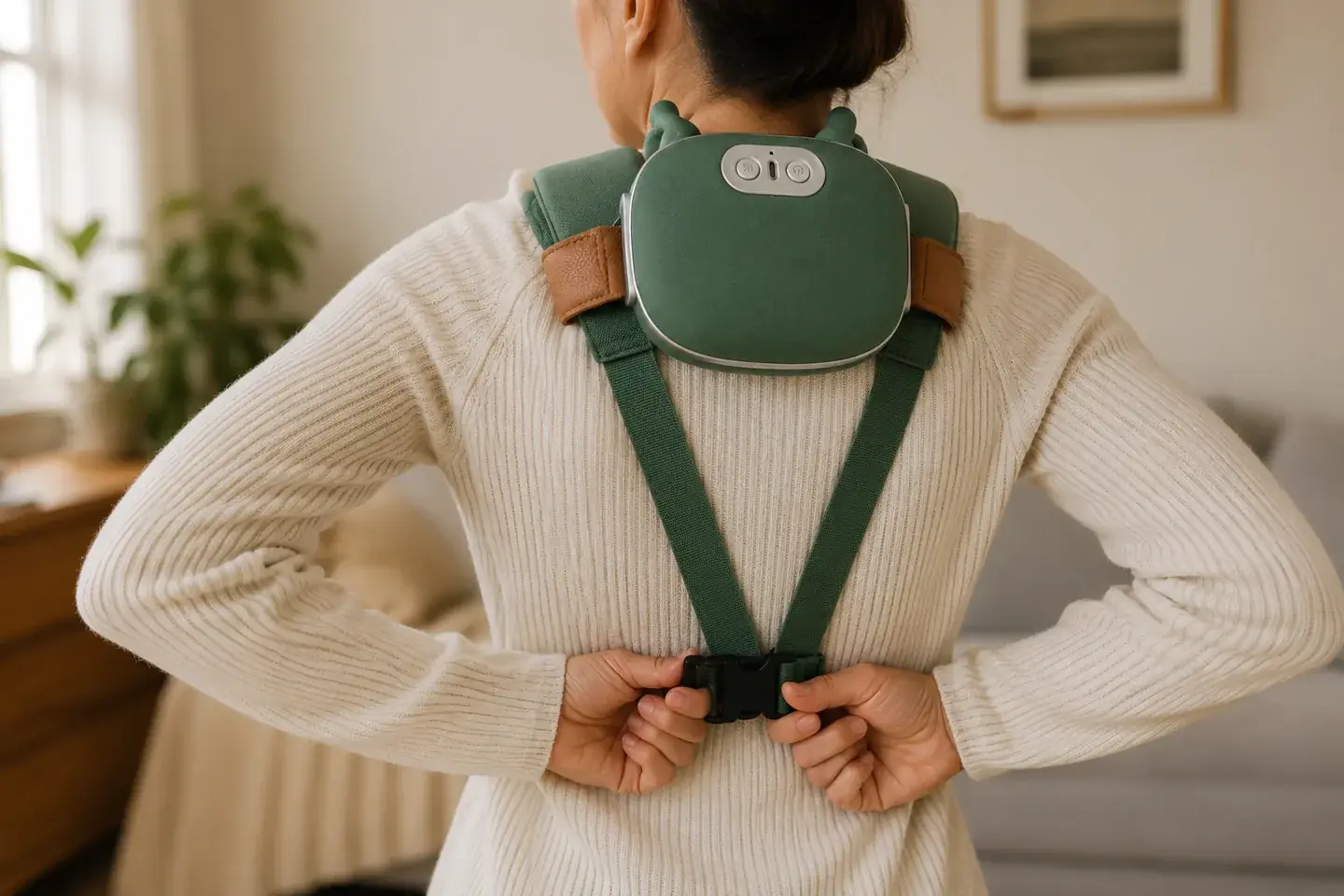
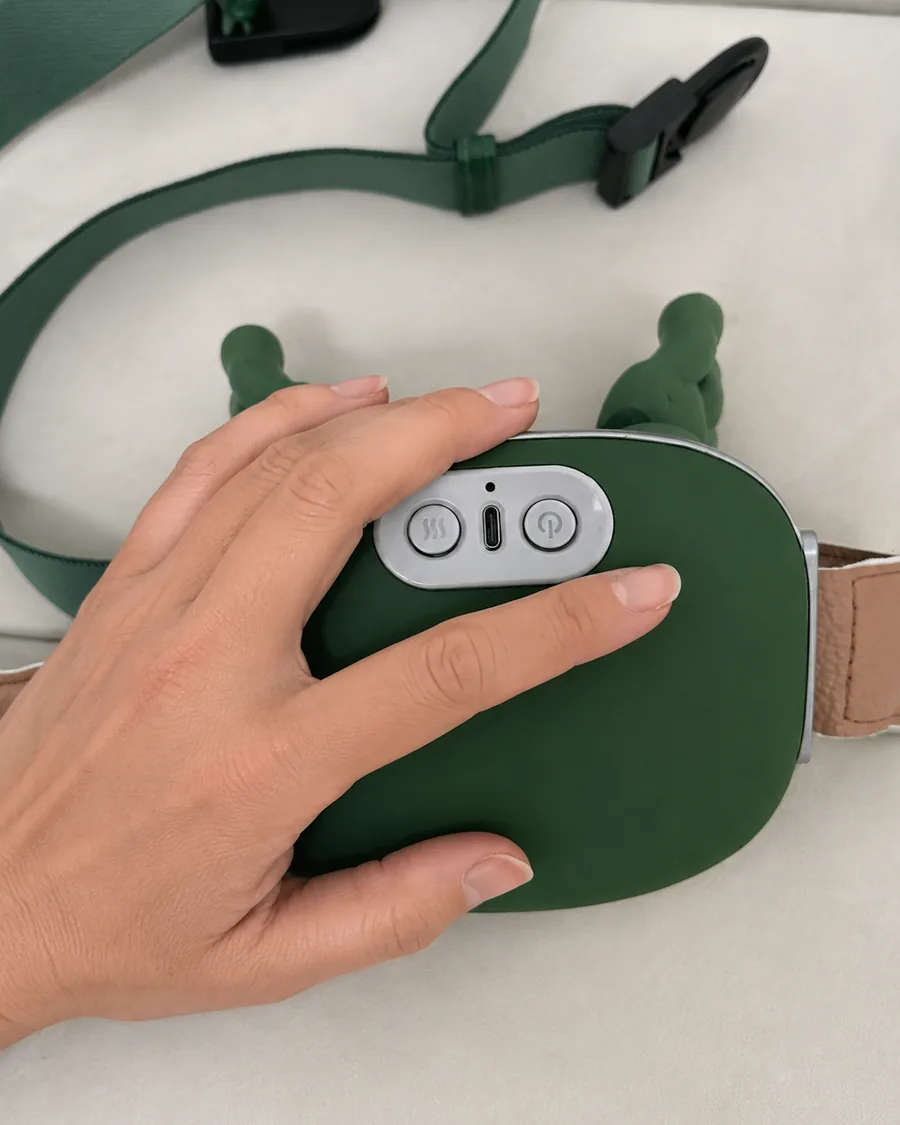
Hands free is the one that decides the six-week question. Handheld devices demand the exact posture that caused the problem: shoulder raised, elbow up, arm holding a weight steady for ten minutes. Ten minutes of that is isometric work for the muscle you were trying to relax. It is why handheld devices photograph well and get used twice.
A shoulder-worn device inverts it. You sit down, it sits on you, and once the buckle is closed your hands are doing nothing at all. That last part is the second-order benefit almost nobody mentions in a specification list: the firmness is set by the buckle, so a device that feels too strong is loosened rather than argued with.
What the specification sheet will not tell you
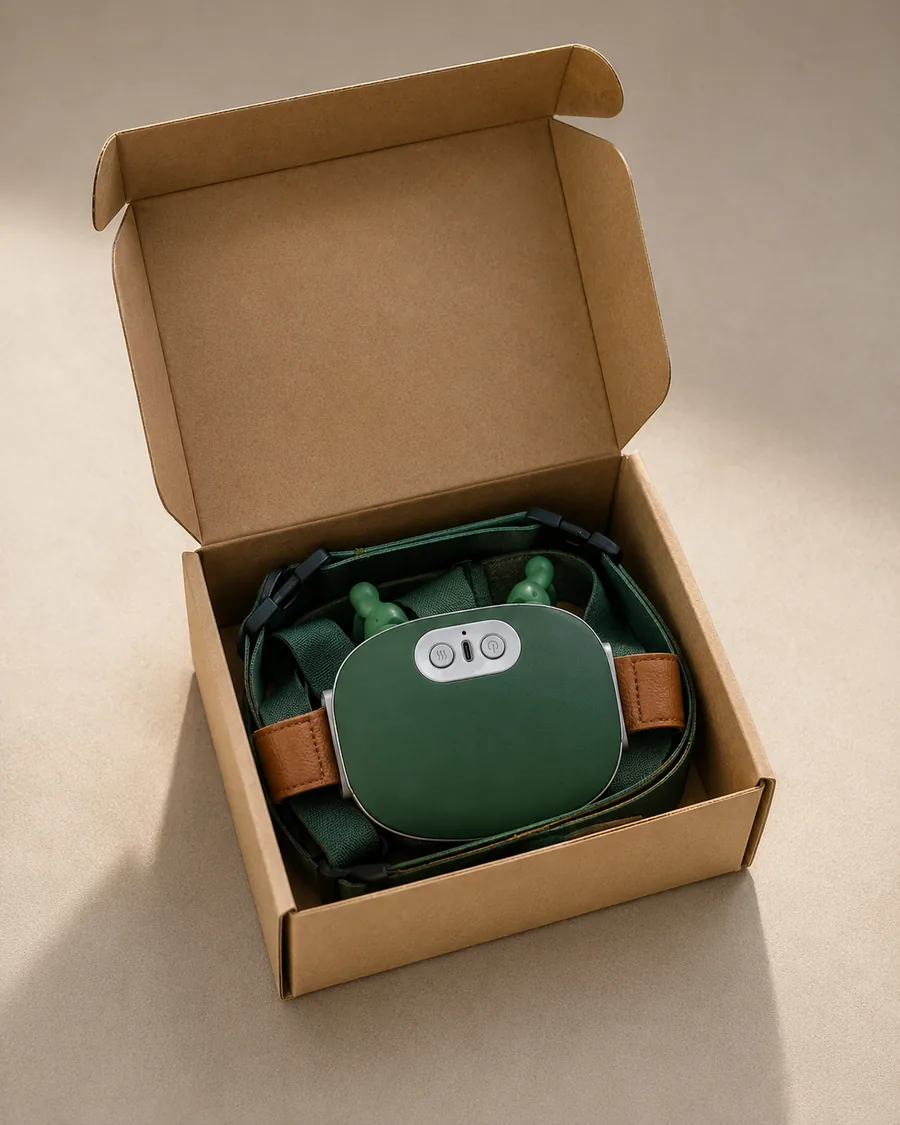
Two things are worth knowing before the box arrives, and neither appears on any product page we have seen. The first is that the battery arrives empty, so the first session waits about three hours. Several buyers mention it, and it is the most common surprise on opening the box. The second is that changing the mode once the device is already resting on your neck means raising an arm, which is mildly awkward — set the mode and the heat you want before you settle back.
The zones are the third thing, because the device and the sheet disagree in both directions. The device reaches the calves, which no documentation we hold mentions. It does not sit flat against the upper back, because the arms do not open wide enough outwards. Both findings are on the product page, in a table, including the one that is not flattering.
What buyers report after living with one
The reports that recur on ours are about firmness and fit. One buyer writes that it massages very firmly and that the pressure is unmistakable even on a slim neck. Another describes it as like two hands on the neck, and adds that it works on other parts of the body too. A third notes that the buckle is generous and fits larger builds — which matters on a device whose whole adjustment is the strap. The eleven we hold are on the reviews page.
The other number to look at is what the rating is calculated on. Ours is 4.9 across 1,462 ratings, and that figure exists because one, two and three-star ratings were removed from the raw set and the average recalculated on what remained. We say so rather than presenting the result as though it fell out of the sky.
If you are choosing the best neck massager by shape rather than brand
The three shapes in this category do different jobs, and the comparison on the home page lays them out side by side. Briefly: a shawl works the band across the neck and shoulders and reaches past it; a collar is the most compact; a pillow needs something to press against. Our detailed guide to picking one is in how to choose a neck massager, and the mechanism itself is explained on the shiatsu page.
Before you decide on the best neck massager
What should I look for first in a neck massager?
Whether it kneads or vibrates. Everything else is a refinement of that one choice. Kneading applies pressure to one point at a time and releases it, which is what a contracted muscle responds to. Vibration spreads a small amount of energy thinly across the whole surface, which feels pleasant and does considerably less.
Does a more expensive neck massager work better?
Not reliably. Price in this category tracks brand and retail channel more than mechanism, and the six traits that decide whether a device gets used are visible in the product photographs. Count the contact points, look for a cable, and check whether the pressure is set by a dial or by your own hands.
How many massage modes do I actually need?
Three is enough when the real adjustment comes from elsewhere. On a shoulder-worn device the firmness comes from the strap as much as from the mode: leave the buckle a little loose and the same mode is gentler. A device with eight levels and a fixed fit is offering you eight versions of the same pressure.
Is a neck massager worth buying at all?
It is if what tightens on you is the band across the neck and shoulders and it comes back every week. A single session of anything relieves it once. What shifts it is repetition, and repetition is only realistic when the device is in the room with you. The longer version is in the guide on where a massager earns its place.